
Mark McMinn, 11/16/25
“That Line Through My Heart” Luke 6:37-49
As we continue through the book of Luke, Mark McMinn explores how Jesus’s teaching in Luke 6 turns religion inside out—inviting us from judgment to mercy, from blind leadership to humble learning, from rigid categories to patient discernment. This message invites us to imagine when grace overflows and reshapes our hearts.
(Due to a recording error, there is no audio recording of Mark’s message for the podcast. However, Mark has offered the transcript of his message.)

That Line through My Heart
Luke 6:37-49
How far apart do you suppose these lines are? If we had some of our youth and young adults get a running start from that door, do you think they could jump that far?
Or here’s another question. Did you know Larry was once a state wrestling champion? That was a few years ago. I wonder if Larry could still make the jump.
Let’s notice the judgments we’ve just made. We made a judgment about how far these two lines are apart. And about whether some of our youth could make that leap. Whether Larry could. Maybe about whether we ourselves could make the jump. I made a judgment about stooping down at age 67 and whether I could stand back up without embarrassing myself. (I may have practiced at home).
It turns out, we make judgments all the time. The Oregon Rules of the Road specify how far we should stop in front of a railroad crossing. It’s 15 feet. So, should we travel with a tape measure to be sure we get this right? No, we make a judgment.
But the first thing we see in today’s passage is Jesus saying, “Do not judge.” Hmm…
Maybe Jesus means we can make judgments about everyday events but not about other people. Well, that’s not so simple either. Imagine a friend comes to your door with this look on her face…
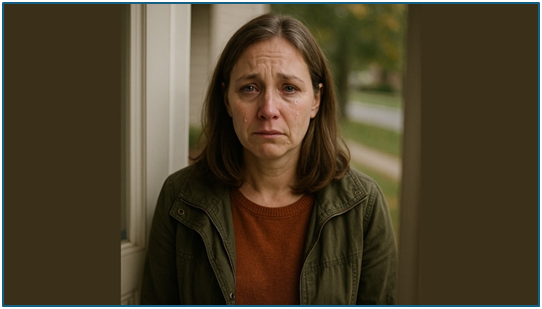
(In case you’re wondering, I don’t know who this is—it’s AI generated). But if the real version of this person shows up on your porch, you’ll need to make a quick judgment about her situation and how to best respond. Compassion demands judgment here.
So, what does Jesus mean about not judging?
Well, maybe it’s a translation issue. Maybe the Greek means something different than our English word.
But just a few chapters later, in a different sermon, Jesus says to the crowd, “judge for yourselves what is right.” And it’s the same Greek word.
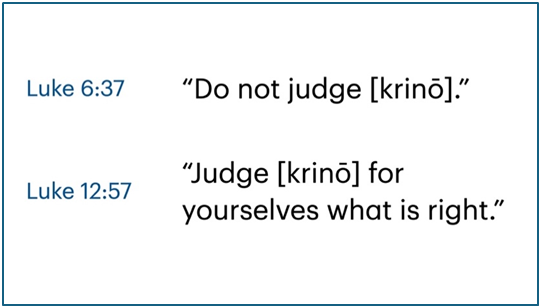
Luke 6—don’t judge, Luke 12—do judge.
Let’s pause and notice what’s happening. I’m getting wrapped up in nuance and Greek words, and if I keep going on this path, I’ll be like the religious leaders Jesus is concerned about—analyzing every detail, parsing every word, but missing the heart of God.
Let’s not do that. Instead, let’s try to back up and look for the larger view of what Jesus is saying.
As a reminder, in Luke 6 we’re jumping into the middle of a sermon Jesus is giving, sometimes called The Sermon on the Plain.

I imagine a lot of us have heard sermons on a plane. Thankfully, Jesus is a far better teacher than the guy in 19C.
The sermon on the P-L-A-I-N is a radical one. Colin started us on this sermon two weeks ago, noting how Jesus is turning religion upside-down: the poor are blessed, the rich await sorrows. Then last week, Bill invited us to consider another upside-down idea. What if loved our enemies?
In today’s passage, Jesus is wrapping up this radical sermon with four vivid word pictures. N.T. Wright, the English theologian, notes that these word pictures are intended to be exaggerated, bigger-than-life, cartoonish, even funny.
So, let’s look at the four word pictures, then we’ll circle back to what Jesus says about judging others.
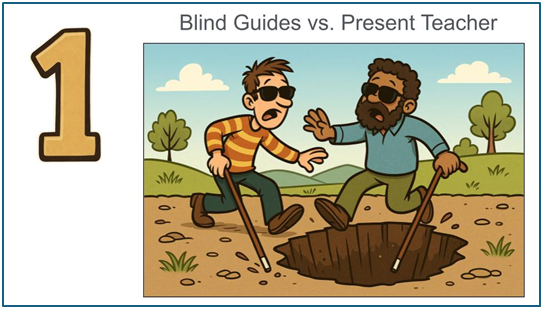
Blind Guides vs. Present Teacher
We might title the first picture, Blind Guides vs. Present Teacher
Each of these word pictures carries a jolt to get our attention. Jesus isn’t mocking people with disabilities here, but he’s using the frail realities of our physical bodies to make an important point.
Here would be another example. I don’t hear well, which was one reason I retired from college teaching early. The teachers in the room, and the students, know how important dialog is, both inside and outside the classroom, and I was losing my ability to do that well. At first, I thought it was because my students were talking so quietly, but no.
Our frail bodies have limitations, and if one of those is eyesight, we probably shouldn’t be guiding others around.
It’s not hard to figure out who Jesus is talking about here. In another sermon, recorded in Matthew 23, Jesus calls religious influencers of his day “blind”—not once, but five times in that sermon.
And if that’s who we’re following, well, watch out for that ditch.
Note the contrast here. Jesus is standing right there on what Luke describes as a “level area,”—no podium, no notes, no microphone. He’s just right there, making eye contact, noticing the nods and the smiles and the tears in the crowd. Jesus, the truest teacher who’s ever walked the earth. How much better would it be to follow Jesus than blind religious influencers?
That’s the first word picture.
Hypocrisy vs. Humility
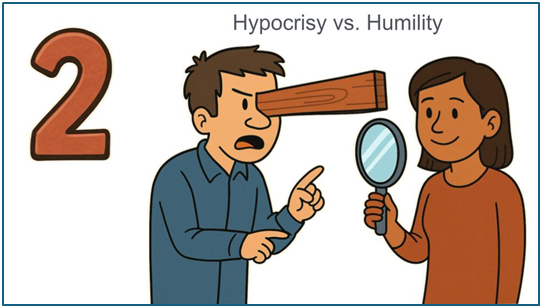
The next word picture, a pretty famous one, is about hypocrisy vs. humility.
Again, it’s exaggerated to make a point. None of us really walks around with a log in our eye, but the point Jesus makes is so important, today as much as ever.
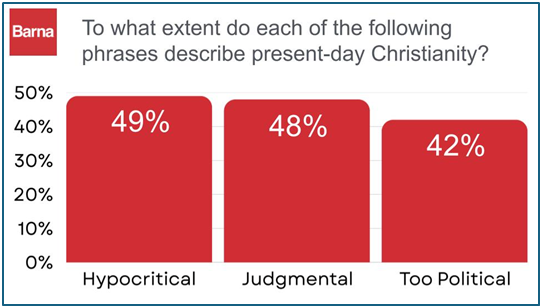
The Barna organization recently asked people with no religious affiliation what they thought of present-day Christianity.
Here were the highest three responses: Hypocritical, Judgmental, and Too Political.
I had breakfast with my friend, Winston, a couple of weeks ago, and when I came home discovered a little blue spot on my beard and realized I hadn’t completely rinsed my face after brushing my teeth. So (with the help of AI again), here’s the exaggerated version.
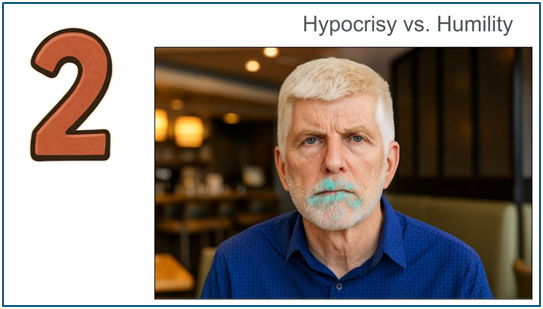
What if, while sitting at J’s, I leaned over and said, “Winston, I notice a bit of spinach on your tooth.”
Nobody really has this much toothpaste on their face, and nobody really has a log in their eye, but the point shines through because of the exaggeration: It’s so much easier to see fault in others than in ourselves.
This is why 93% of us believe we’re better-than-average drivers.
Categorizing vs. Discerning
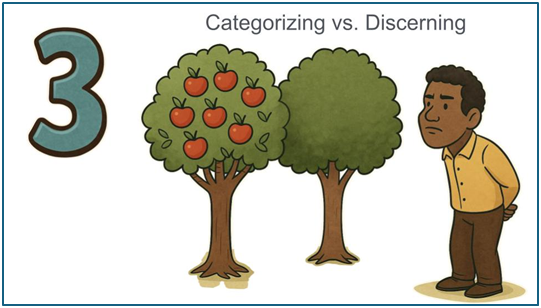
The third word picture could be titled categorizing vs. discerning.
At first glance, it looks like Jesus is boxing up the world here—like there are two containers named good and bad. Good trees, bad trees, good people, bad people, good hearts, bad hearts. But that just doesn’t fit the flow of his sermon. He’s actually warning against our tendency to make snap judgments—to categorize people, because real discernment takes time. He uses fruit as an illustration, which I love because Lisa and I grow fruit, and it takes both patience and discernment.
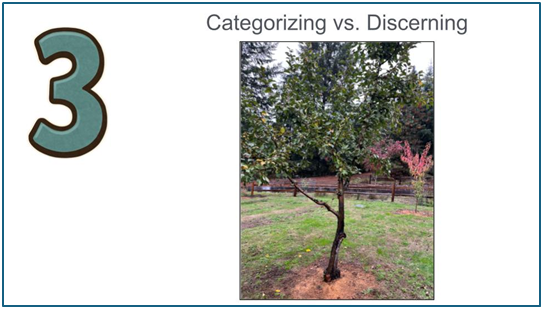
We have this wounded apple tree at our place. The trunk’s discolored, the bark doesn’t wrap all the way around the trunk, it leans, one of the scaffold limbs broke off a few years ago. Anyone who looks at this tree would say it’s a bad tree.
But every September it produces the most delicious Honeycrisp apples. And Jesus says people can be like this, too — don’t prejudge, wait and see what a life produces.
Several weeks ago, Joel taught from a passage earlier in Luke 6 where the religious leaders criticized Jesus because his disciples broke a Sabbath rule by picking grain and rubbing off the husks. Oh, and Jesus healed a man on the Sabbath.
The Pharisees were getting all tangled up in nuance and rules and labels and couldn’t see Jesus apart from their categories. The alternative, Jesus reminds us, is to patiently discern what emerges out of the treasury of our hearts.
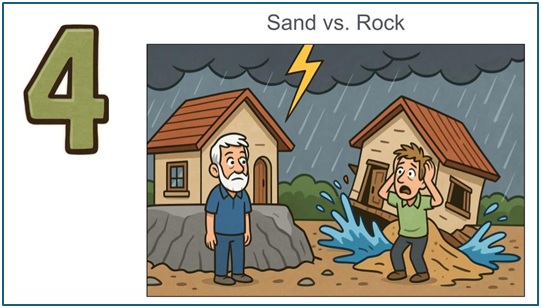
Sand vs. Rock
The final word picture is about two builders — one on sand, one on rock.
Can you imagine going to Lincoln City and seeing someone framing a house right out on the beach? It’s another exaggerated picture Jesus is offering.
When my kids were young, I remember learning a song called, “The Wise Man Built His House Upon the Rock.” It came with hand motions, which I don’t remember, but I remember the verse about the foolish guy building a house on the sand. It ends with the word, “Splat.” Not wobble, not creak, but splat.
Splat is a pretty good summary of these four word pictures Jesus offers here—all exaggerated, all vivid, all slightly humorous to his audience, all carefully chosen to support his main point. So let’s not miss his main point, which to offer a contrast between a religious system that wasn’t working very well, and a new possibility.
Circling Back and Drawing Lines
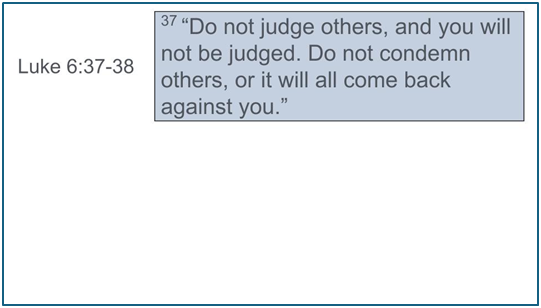
Let’s circle back now to the passage about not judging and look for this contrast.
“Do not judge others, and you will not be judged. Do not condemn others, or it will all come back against you.
Here’s one option. We could use condemnation and shame to get people to act the way we think they should. Yeah, that could work. I suppose it does work. Every day. But Jesus offers another way.
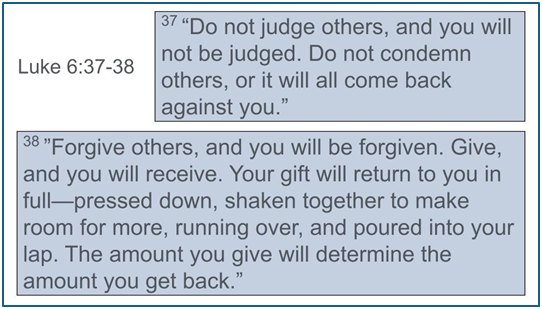
Forgive others, and you will be forgiven. Give, and you will receive. Your gift will return to you in full—pressed down, shaken together to make room for more, running over, and poured into your lap. The amount you give will determine the amount you get back.”
That’s a different way of being in the world. Rather than using judgment and condemnation to enforce conformity, what might happen if we lived more softly, with hearts of forgiveness and grace?
So I made a summary chart.
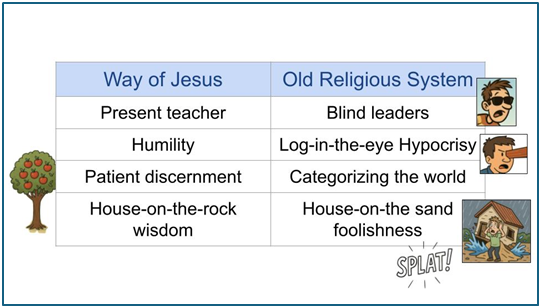
Lisa will tell you I like to build charts and spreadsheets for everything.
The four word pictures Jesus offers, they all illustrate this contrast between a new way and the old religious system. On one side is forgiveness, humility, seeking the heart of God. On the other side is harsh judgment, hypocrisy, spiritual blindness.
Aren’t summary charts grand? Well yes, until they aren’t.
Because now, summary chart in hand, we may be inclined to draw a line down the middle.
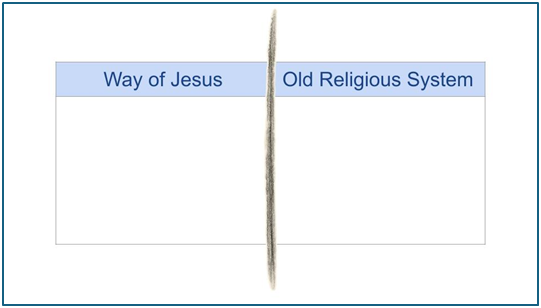
On one side, we have this new way of Jesus while the other side consists of stuffy, hypocritical Pharisees.
It makes sense that we draw this line because it’s what Jesus does in his sermon, and even more so when we get to Luke 11 where he uses stronger language about the religious leaders of his day.
The problem is, we’re not Jesus. We don’t have his clarity, his wisdom, his full divinity. We’re not speaking into the same cultural moment he faced. Our hearts and our minds get tangled in ways his didn’t.
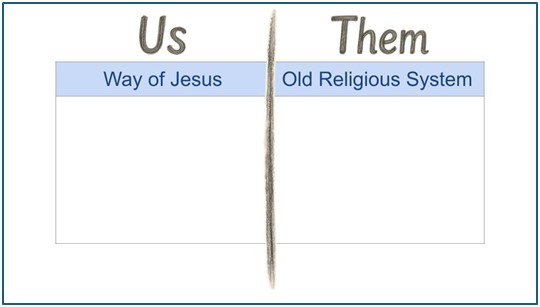
And after drawing this line, we might tend to slap labels on each side.
Pretty soon we’re tossing people into the “Them” category, conveniently located on the right side of my chart. You know, the legalistic ones, the fundamentalists, the rigid people who don’t know how to love others very well. But over here on our side of the line, we’re in pretty good shape.
And honestly, if you press me on this, I find it compelling. I love this community. There is so much grace here. So much love. I’m so grateful for “Us.” We are Friends. Friends of Jesus, and I believe that.
But at some point, my visual chart and all it represents in my heart might cause me to do the very thing Jesus is teaching against. Because once I’ve tossed someone into the “Them” category, I’ve judged them, maybe unfairly.
Just 12 chapters ahead in Luke’s account, there’s this religious guy standing in the Temple, thanking God that he is so much better than that other guy over there. Meanwhile that other guy is praying a line that’s echoed through Christian history and helped shape what later became known as the Jesus Prayer: “God be merciful to me, a sinner.”
Which of these two stands closer to the heart of God?
And here’s where the Sermon on the Plain stops being about those religious snobs out there—and becomes about the alignment of our own hearts.
In my field of psychology, we have thousands of studies demonstrating something called self-enhancement. We tend to perceive the world in a way that puts us in a favorable light while seeing others less favorably. When I said earlier that 93% of us think we’re above average drivers, I didn’t make that number up. It’s a real thing.
So, we at least need to ask the question, is there a better place to draw this line?

Aleksandr Solzhenitsyn was a Russian novelist and Orthodox Christian who spent 8 years as a political prisoner in the Siberian Gulag. Sometime later, when his book The Gulag Archipelago came out, people expected a scathing exposé of Soviet brutality. But it turned out to be something different—more of a profound reflection on the moral and spiritual condition of humanity itself. Solzhenitsyn wrote this:
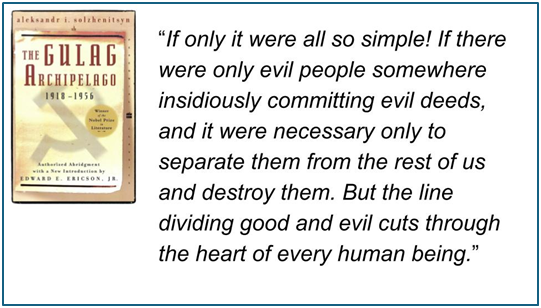
If only it were all so simple! If there were only evil people somewhere insidiously committing evil deeds, and it were necessary only to separate them from the rest of us and destroy them. But the line dividing good and evil cuts through the heart of every human being.
And if the line runs through every human heart, then the work of faith is not to stand on one side of the line looking askance at the others, but to stay awake to what’s happening in my own heart—what’s growing, what’s hardening, what needs mercy.
Sometimes this involves getting in touch with my own inner Pharisee, that blind guide living right in my heart, that impulsive person who starts framing a house on the sand. I’ve done that. Maybe not literally, but yes, I’ve done that.
Jesus makes it so clear in his sermon: Before we try to locate the problems in others, we need to look at ourselves.
In Blue Like Jazz, Donald Miller writes about showing up at a protest with a sign that reads, “I am the problem.”

Miller’s exaggerating here to make a point, much like Jesus did in his sermon. I doubt Miller ever really showed up at a protest with this sign.
But his point is worth considering. Christians often speak about justice. And that’s good. Absolutely, unequivocally, justice matters. Throughout scripture we see God calling for justice, and we should, too. Still, it’s worth noting that today’s language of justice tends to locate the problem “out there,” with other people and other groups. And it’s humbling to remember the Pharisees believed they were calling for justice, too, following what they thought the scriptures taught.
So yes, let’s pursue justice. Absolutely. And let’s love mercy. And let’s walk humbly (Micah 6:8).

Friends, we need a village to help discern these lines in our hearts. Thank you for being that village for me.
And as we village together, let’s also remember how Jesus names the good in our hearts—forgiveness, kindness, humility, generosity, love. Pressed down, shaken together, running over, overflowing in every direction.
If you’ve been to Silver Falls in the winter, you know what overflowing looks like—water pouring over rocks, rushing, splashing on everyone who comes close. There is so much good in these hearts of ours, so much good in the heart of this community, and maybe even in the hearts of those we perceive as enemies.
I said earlier that I didn’t want to get tangled in details and miss the heart of God this morning. For those of you who were here last week, didn’t it seem that we moved very close to the heart of God as we pondered what it might mean to love our enemies?
As we enter the silence of open worship, I don’t have queries—just a picture.